

Dominant and Aggressive State
- Explanation
When a dog is in a dominant or aggressive state, its body language changes clearly and conveys control or an intention to fight and drive others away. A dominant dog may position its body in a large and impressive way, standing upright with straight legs, which indicates a sense of confidence and belief in its abilities. The tail will be raised, and sometimes held in an erect or almost vertical position, while the ears will be forward, or even standing in a stiff position directed forward, when the dog is expecting some signal from others.
That said, there are differences between types of dominance and aggression that are expressed in body language and in the nature of the behavior:
Ordinary dominance: An ordinarily dominant dog will not necessarily display signs of aggression toward those around it, but it will definitely display control and complete confidence. It may stand with an erect body, not avoid direct contact with others, and take the place it deserves, without avoiding approaching objects or people in the environment. Its eyes will be focused, but not necessarily aggressive, and the general response will be one of confidence and control of the situation.
Aggressive dominance: An aggressively dominant dog will display much more forcefulness and may avoid contact with everyone around it. The tail will be raised and stiff, the ears will be forward but look more tense, and the sense of vulnerability will disappear. Its gaze will be aggressive, and when it feels threatened or uncomfortable, it may show signs of threat, such as loud or combative barking. Such a dog may show signs of aggression if someone tries to challenge its place or if it feels the environment is not under its control.
Defensive aggression: A defensively aggressive dog does not necessarily seek to be dominant, but it will display aggression as a response to a situation in which it feels threatened. Such a dog may stand in an erect manner, but with a tail curved downward or at the lower end, folded ears, and tense facial expressions. This behavior stems from a sense of helplessness and the need to distance the environment from it or to deter stimuli that feel threatening to it. The dog may bark, bite, or threaten with a sharp movement in order to drive away the threat.
In summary, a dog in a dominant state can be calm, aggressive, or defensive depending on the situation it is in. Each different state indicates different responses to stimuli, and if dog owners understand this body language, they can manage the various behaviors in a way that prevents a threat and helps create a balanced and safe environment.
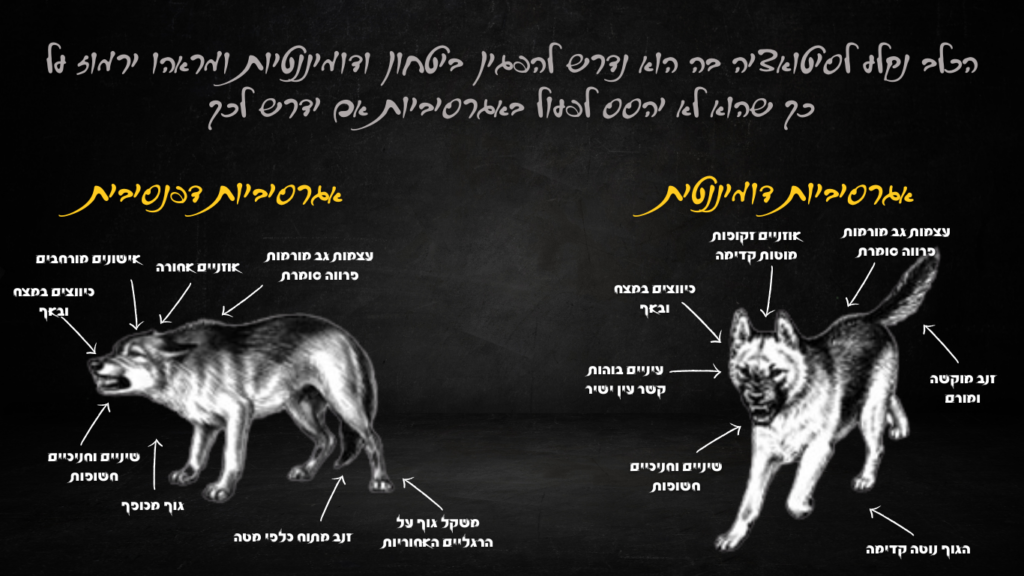
Body Language
- Head
The dog’s head will be raised, turned forward or slightly upward. It will not draw back or bend, but will remain stable and focused on the stimuli around it. The dog will display self-confidence by keeping its head erect, which indicates complete control of the situation. Its eyes will be focused, with a penetrating but not necessarily aggressive gaze, and it may avoid direct eye contact if it feels in control of the situation. The facial expressions will be calm but sharp, conveying a sense of control and assertiveness.
- Ears
The dog’s ears may be stiff and rise forward sharply, especially when it is dealing with a stimulus it wants to control. If the ears are slightly folded backward, this may indicate a sense of threat or challenge from another dog, despite maintaining dominance. Ears directed forward convey readiness and alertness, and this state is expressed especially when the dog feels it needs to make its status clear.
- Mouth
The dog’s mouth will be open or closed to a varying degree, but will usually look tense or strongly closed. The lips will be tense or firm; sometimes teeth can be seen slightly, especially if the dog feels its status is threatened. If the dog conveys aggression, an exposure of teeth will be visible, and the mouth can open more sharply, which indicates an intention to deter or fight.
- Tongue
The dog’s tongue will usually remain inside the mouth or be in a neutral position, meaning it will not protrude noticeably. However, in situations of high tension, the dog may let its tongue out and place it outside slightly, which can indicate alertness. The tongue will usually remain loose and will not indicate relaxation, and the general behavior will be one that includes readiness for action, without looking released or calm.
- Body
The dog’s body posture will be erect, strong, and impressive. The dog will stand or sit in a stable manner, with straight legs spread wide, so that it takes up more space in the environment. The back will remain straight and tense, which indicates control and high self-confidence. A dominant dog will not bend its body downward or crouch, but will display stability and control in every movement. If it is in motion, it will move sharply and attentively, when its whole body devotes attention to the stimuli around it, while maintaining a stable and focused stance.
- Tail
The dog’s tail will usually be raised, straight or almost vertical, which indicates a sense of control and confidence. The tail may be firm and stiff, sometimes with small movements of slight vibration if the dog is very tense. The tail will not be loose or turned downward, but will stand in a posture that signals the dog is ready to control the environment and deal with challenges. In situations of high tension, the tail may be stable and directed backward, but will always convey a stable and assertive stance.
- How to read body language? Tips and more articles