
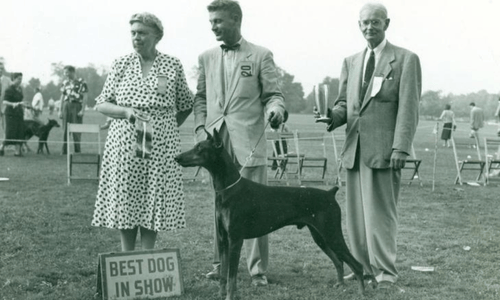

Doberman Pinscher
History and Background
The Doberman Pinscher, also known as the Doberman, is a dog breed developed in Germany in the late 19th century by Karl Friedrich Louis Dobermann. Dobermann, who was a tax collector and night watchman, sought to create a reliable and brave guard dog to accompany him in his work. To this end, he crossed various breeds, most likely the Rottweiler, German Pinscher, Greyhound, and possibly also the Weimaraner, in order to achieve the desired traits.
Breed Details
Easygoing with Training
Shedding
Life Expectancy
Pet-Friendly
Family-Friendly
Breed Size
Breed Size
Family-Friendly
Pet-Friendly
Easygoing with Training
Shedding
Life Expectancy
More Breed Details
Life Expectancy
Life Expectancy
10–13 years

Male Weight
Male Weight
Males and females 29–41 kg
Female Weight
Female Weight
Males and females 29–41 kg

Male Height
Male Height
Males 66–72 cm
Female Height
Female Height
Females 61–68 cm

Weather Sensitivity
Weather Sensitivity
Due to its short coat, the Doberman is sensitive to cold and should be protected in cold weather

Energy Level
Energy Level
High

Coat Characteristics
Short, smooth, glossy coat. Coat colors include black, brown, blue, and rarely also "Isabella" (light brown)

Hereditary Diseases
Hereditary Diseases
Dilated cardiomyopathy (DCM), von Willebrand disease (a blood-clotting disorder), hip dysplasia, and gastric torsion (bloat)
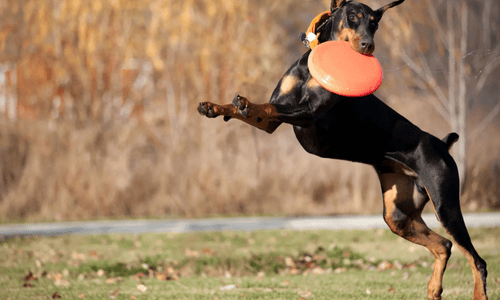
The Breed's Purpose Today
Today, the Doberman serves as a working dog in a variety of fields, including police, military, search and rescue, and as a service dog. In addition, it serves as a loyal and devoted companion dog for families
Tips for Training and Educating the Breed
- Early socialization: It is important to expose the Doberman to a variety of people, animals, and environments from a young age in order to develop friendly and confident behavior.
- Consistent, positive training: Using positive reinforcement, such as treats and praise, will aid learning and reinforce the desired behavior.
- Physical and mental activity: The Doberman needs daily activity, such as walks, running, and play, to prevent boredom and destructive behavior.
- Clear leadership: The breed needs an owner who demonstrates confident and consistent leadership, with defined boundaries and a loving attitude.
The Doberman Pinscher is a medium-to-large, intelligent, and loyal dog, suited to families seeking a devoted and active companion. With attention to training, socialization, grooming, and sufficient physical activity, it can be a wonderful addition to any home.